
The majority of young people in Nova Scotia aren’t investing and have little knowledge about investing. In the latest Investor Index study conducted in 2017, it was found that only 36 per cent of those polled between the age of 18 and 24 had some form of investments. Even more troubling, the Index also found that 67 percent of those polled between 18 and 24 had a low knowledge of investments. Additonally, only six per cent had a high knowledge.
Having a low knowledge of investments and finances in general can be the beginning of a difficult financial path that could include poor money management, poorly managed investing or even falling victim tp investment fraud. Luckily, we’re here to help.
This page includes information on investing that young investors can use to gain a basic knowledge of investments to help assist is making informed investment decisions now and in the future. This includes information on what investing is and why it is important. The different types of basic investments and a primer on cryptocurrencies and initial coin offerings. We also delve into saving for post-secondary education, long-term and short-term investment savings, and advisers and robo-advisers.

Part One: What is investing?
Part Two: Why should I invest?
Part Three: All about RESPs

Why should I invest? What is investing anyway? If you’re looking for the basics on investing and why it is important for your future and financial goals you’ll find it here.
- What is investing?
- Why invest?
- How do I get started investing?
- What is the difference between saving and investing?

Now that you know what investing is and why it is important, where can you invest? This section plainly details some of the investments that are available to you.
- Bonds
- Equities
- Mutual Funds
- Exchange-Traded Funds (ETFs)
- What is the difference between a mutual fund and an ETF?
- GICs
- Debentures
- Alternative Investments

Cryptocurrencies and Initial Coin Offerings are hot topics these days. Some people see them as the next big investment, while other sees them as risky speculation. From a regulation standpoint are they securities? Are they regulated and what are the risks? Learn more about crypto and ICOs and why you should be extremely cautious when considering them.
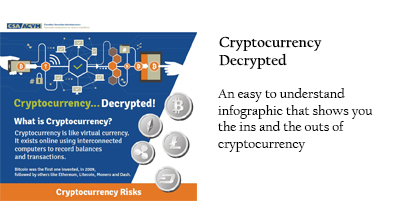
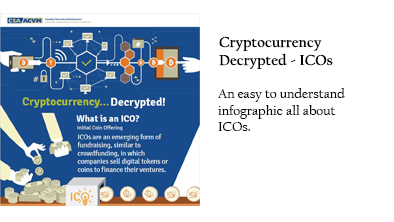
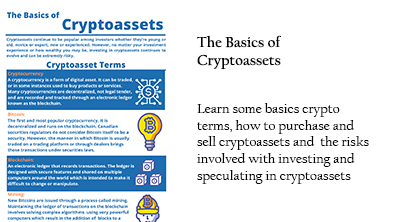
- What is a cryptocurrency exchange?
- The risks of cryptocurrencies and ICOs
- Is an ICO a security?
- Do ICOs have disclosure requirements?
- Are crypto trading platforms regulated?
Cryptoassets Video Series:
Part 1 Crypto Terms
Part 2 Purchasing and Selling Cryptoassets
Part 3 Cryptoassets Risks

Are you saving for university or college? Maybe you’re a parent of a newborn child or an older child wondering what your investment options are for their post-secondary education future.
- What is a Registered Education Savings Plan (RESP)?
- What happens to a RESP if I don’t go to university or college?
- Can an RESP hold different investments?

If you’re new to investing how are you going to manage your investments? Maybe you’ll find an investment adviser. Maybe you’ll go a different route and choose a robo-adviser to manage your funds. Learn what a registered adviser is, and why registration is important in the links below. You should also learn what a robo-adviser is to know what the best option is for you and your money.
- What is a registered adviser?
- Why do I need an adviser?
- How do I find an adviser that’s right for me?
- What is a robo-adviser?
- Are robo-advisers registered?

What are you investing for? School? A car or some other large purchase in the future? Maybe you’ve already started to save for retirement. Knowing the difference between RRSP and TFSA accounts can help you direct your money and your savings correctly so it will be there and available when you need it.
- What is the difference between RRSP and TFSA investment accounts?
- Are RRSPs securities?
- What are the age limitations on RRSPs and TFSAs?
 (Updated October, 2025)
School is back in session which means the Nova Scotia Securities Commission has relaunched the Student Connections Program.
During the 2024-25 school year Commission staff visited high schools, colleges and universities across the province, both in person and virtually. Just a few of the schools we visited included C.P. Allen High School, Lockview High School, Woodlawn High School, Saint Mary’s University, and Dalhousie University.
For the 2025-26 school year we hope to continue to reach more students and youth and to develop relationships with new schools and student and youth organizations throughout Nova Scotia.
The goal of the Student Connections Program is to deliver relevant investment information and knowledge to students before they need it. Students exiting post-secondary education are entering a new phase in their life with careers, money, and a future ahead of them. This future could include a family, their first home, cars, and investing for their children’s education and their own retirement. As life becomes real, the need to invest also becomes real. So, why do they need to wait to learn about investing? Why can’t a foundation of basic investment knowledge be gained before it is time to use it instead of learning from mistakes and catching up on investment knowledge later in life?
Presentations on investing can be delivered to classes and student or youth organizations on several different topics, including but not limited to:
- An Introduction to the Nova Scotia Securities Commission,
- Basic Investing,
- DIY Investing,
- Crypto Assets and Securities Regulations, and
- Investment Fraud and Scams.
We are also able to deliver presentations on more specific topics such as CEDIFs, Capital Raising, and Registration for Working in the Investment Industry for students interested in working in the investment industry or raising business capital in the future.
If you are interested in one of these presentations or would like more information on what the Nova Scotia Securities Commission Student Connections program can offer you, your class, group, or organization, please contact us.